












































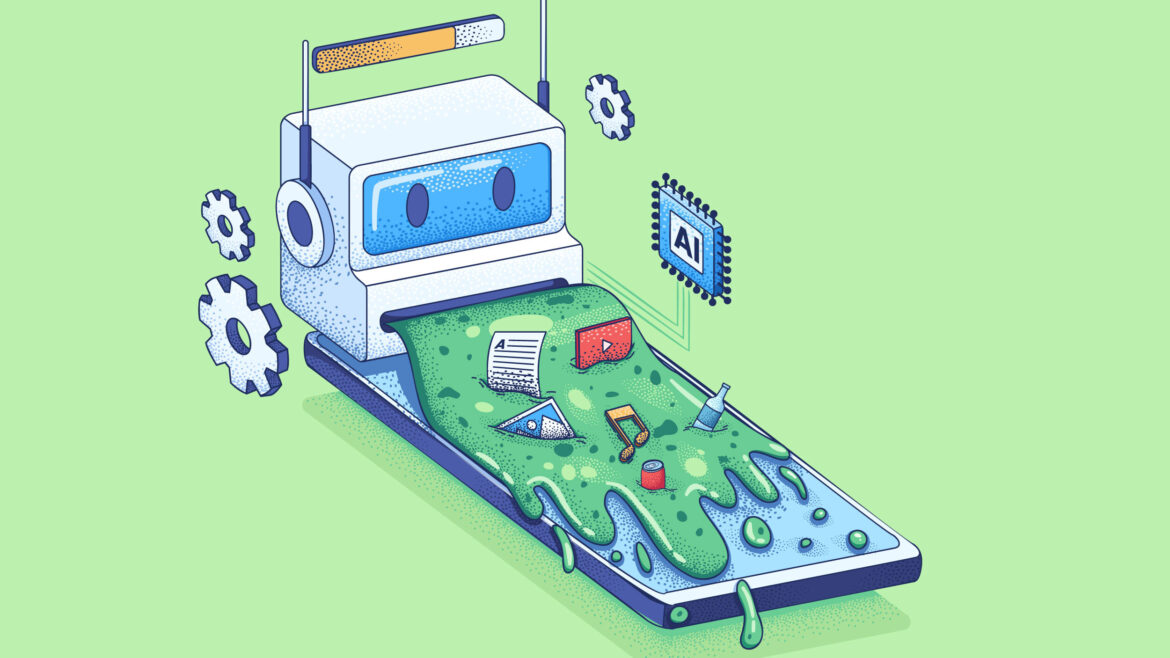
Credit union employees are experts at wearing many hats, taking on a few different roles within the credit union. This is often a necessity, especially for smaller credit unions, which need to make much more careful use of their budgets and staff members.
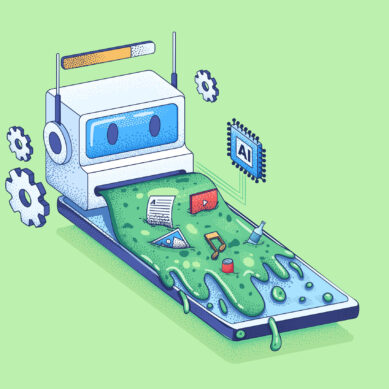
In that sense, AI can feel like adding an extra set of hands (or five) to the team with few consequences to the budget. And certainly, AI absolutely has its uses and can help make repetitive and laborious credit union processes much more efficient, freeing up precious time for employees to work on more critical tasks like helping members.
That being said, your marketing is not one of those repetitive tasks that should be handed off to AI—though it’s easy to see why a credit union might be enticed to do so. After all, creating quality marketing materials requires a significant amount of time, energy, and money (even if just to provide employees with the basic technology and resources they need).
Perhaps a credit union had been struggling to find the time and manpower to keep up with their marketing, and to them, the idea of technology that can instantly create a visually appealing ad that meets their credit union’s specific needs sounds like a dream come true. Who wouldn’t take advantage of that?
Except…AI cannot do those things, and while the cost savings can definitely be tempting, something else will ultimately pay the price for using it: your brand.
AI fatigue and distrust
Unlike other new technologies, using AI in member-facing promotions won’t win you any points. Members—and consumers as a whole—are exhausted by and wholly untrusting of AI-generated content, and the data proves it.
Recent research conducted by The Harris Poll, 4As, and Infillion and reported by Marketing Brew found that 78% of consumers believe AI makes ads “feel less authentic” (and if you’re wondering how critical that authenticity is, a Stackla survey found that an overwhelming 90% of Millennials and Gen Z say authenticity is a key factor in deciding which brands to support).
Additionally, around two-thirds (63%) said they would be “less likely to purchase from a brand that uses AI-generated ads,” while 73% said they would be “less likely to trust an ad” they suspected was made using AI.
But why the lack of trust? Ads are staged to begin with, so why does adding AI change things so drastically? Here’s the rub: consumers may have always known advertising was fake to a degree. There’s a script, actors, editing, etc., but the product being sold is real. The car in the commercial is the actual car being sold. The pictures on the menu were taken at the restaurant and represent real food the chef made.
With AI, consumers know their experience, product, etc. certainly won’t look like that. Why? Because nothing in that photo exists to begin with. If the car in the commercial is now AI-generated, what does the actual car look like? Who knows! If the photos in the menu are AI-generated (and, quite frankly, horrific-looking—I’m talking to you, shrimp donuts and trypophobia burrito), that not only tells the consumer nothing about the actual item being sold to them, but makes them suspicious about why they’re not allowed to see what the real thing looks like.
Plus, it’s not even that consumers just don’t like or trust AI (both of which are true)—they’re sick of it. From that same report, 54% of respondents agreed that they hear so much about AI that “it’s starting to annoy [them],” while 65% of consumers said they would “love if brands would never mention meaningless AI marketing again.” (I recognize the irony of writing about it…)
Ethical concerns may carry over to AI
In addition to AI fatigue, using generative AI may say something about your credit union’s brand and its values that you may not want it to.
In the thousands of articles written on how to understand the younger generations and earn their business, many are quick to talk about how Gen Z and Millennials feel good about doing business with companies that share their values, and will make changes to where they shop, eat, or bank to fit those values.
In fact, according to 5WPR’s 2020 Consumer Culture Report, 83% of millennials said they want companies to align with their values, and a study from Syracuse University found that 81% of Gen Z had changed their decision to buy a product based on a brand’s actions or overall reputation.
Generative AI is very controversial, especially among younger generations. Concerns over copyright infringement, job prospects, environmental impact, and an increasing number of data centers have many up in arms over the technology. Social media users unfollow creators and brands in droves the moment AI appears on a page, commencement speakers get booed at graduation ceremonies for mentioning AI, and even mega-brands like McDonald’s and Coca-Cola have learned firsthand how quickly AI advertising can turn people against brands—even ones they use regularly.
Whether you personally agree with these sentiments or not, the reality is that by choosing to use generative AI in a very public way, you may be making a statement about your credit union’s values—accurate or not and intended or not—that could impact how consumers view your brand.
If you won’t invest in your brand, why should members?
Recently, I came across a credit union ad marketing their auto loans. At first, the graphic seemed like a standard scene of a family gathered around a new car sitting in their driveway. But upon further inspection, there was more than a little off with the image. Limbs were missing and distorted, the family’s faces were a mess of blurred features and odd expressions, the car was sitting sideways on the driveway, and even the house behind them was riddled with impossibilities and oddities.
And these were not subtle mistakes someone would have to really study the image in order to catch; they were large and apparent from even a moment’s glance. It was clear that either A) no one had taken the time to proof the graphic before approving and sending it out, and so the errors were missed, or B) they had noticed the wonky garble the AI had produced and simply didn’t care enough to correct it and assumed no one else would care either.
Ill-designed graphics, videos, ads, or other types of marketing materials have always reflected badly on brands, and adding AI doesn’t change that. When executed poorly, using AI in your marketing materials can make your credit union look sloppy, lazy, or uninvested—even if the truth is that your credit union is investing so much time into helping members that marketing fell to the wayside, it won’t read that way.
Instead, when looking at a hastily approved AI ad riddled with errors and misshapen humans, current and potential members alike might ask, “If they don’t care about their brand, why should I?”
To the loyalists
By this point, I can hear you AI enthusiasts on the other side of the screen saying, “Well, AI is here to stay, so we might as well get used to it and learn how to use it!” Look, I’m not denying that there are certainly areas where AI can be a massive benefit—expediting repetitive tasks, optimizing workflows, and all that. Marketing is just not one of those areas.
As credit unions, it’s our focus on people over profit, our concern for community, and our caring and empathetic approach that makes our movement what it is. It’s the humanity we embed in an industry that’s so often seen as cold and uncaring that defines the credit union difference.
Our marketing is how we often connect with that community and those members. To replace intentional outreach designed by a human with slop created from the generative AI trough (time- and money-saving, though it may be) will not do anything to strengthen credit union brands or build deeper connections with our members.


