












































“One hundred individuals, saving their money individually, could not provide themselves with much protection. But let them organize a credit union, and their opportunity to help themselves was multiplied.” – Edward Filene.
Welcome back to the fourth and final part of Following Filene, our lookback through the Father of U.S. Credit Unions’ journey to building our movement, as part of Credit Union History Month. When we last left Filene, he and Pierre Jay had just successfully brought credit unions to Massachusetts and New York, via the first pieces of credit union legislation in 1909 and 1914 respectively. Thanks to their efforts, credit unions were currently thriving in those two states.
But at that time, despite their successes, there was still little to no knowledge about credit unions in the rest of the country. While the number of credit unions was increasing, they were doing so in a very isolated area and had yet to expand much further than the northeast. In the next era of his work in credit unions, Filene would turn his attention to the national stage with the work of his new partner, Ray Bergengren.
From acorn to oak
In order to make the budding credit union industry into a national movement, Filene and Bergengren needed to tackle the lack of national awareness and legislation surrounding credit unions.
To aid in this effort, Filene created the Credit Union National Extension Bureau (CUNEB) in 1921, financing it almost entirely through Filene’s Twentieth Century Fund, with Bergengren stepping in as director. CUNEB’s goals were “to bring about the laws needed for credit union development in the various states, subsequently, to organize some credit unions in each state that could serve as examples to others, to expand the number of credit unions to the point that they could create self-sustaining state federations, and to combine the federations into a self-sustaining national association.”
While creating legislation nationwide was certainly a priority for the pair, there was little to no chance of such a thing happening until lawmakers were educated on what credit unions were and communities made aware of their impact. Which for Filene and Bergengren, meant taking their act on the road.
And so, thoughout much of the 1920s, Filene and Bergengren traveled though the U.S., on what can only be called a credit union campaign, helping to not only spread awareness about credit unions, but help support communities in starting their own. During this time, Bergebgren also began a publication called The Bridge which shared stories of credit unions helping people and kept track of legislation progress.
Thus, nearly a decade after their country-wide campaign began, Filene and Bergengren’s work had seen thirty-two states pass credit union legislation and 1,100 credit unions had been organized. Their timing was impeccable as well, as the end of that decade also saw the Wall Street Crash of 1929, leading to the start of the Great Depression, and a time when many were untrusting of big banks. Thanks to this distrust, many Americans turned toward credit unions as a community-focused, democratically-led insitutions.
Because of this, and the work Filene and Bergengren over the previous nine years, credit unions came out the other side of the Depression relatively unscathed.
Getting national recognition
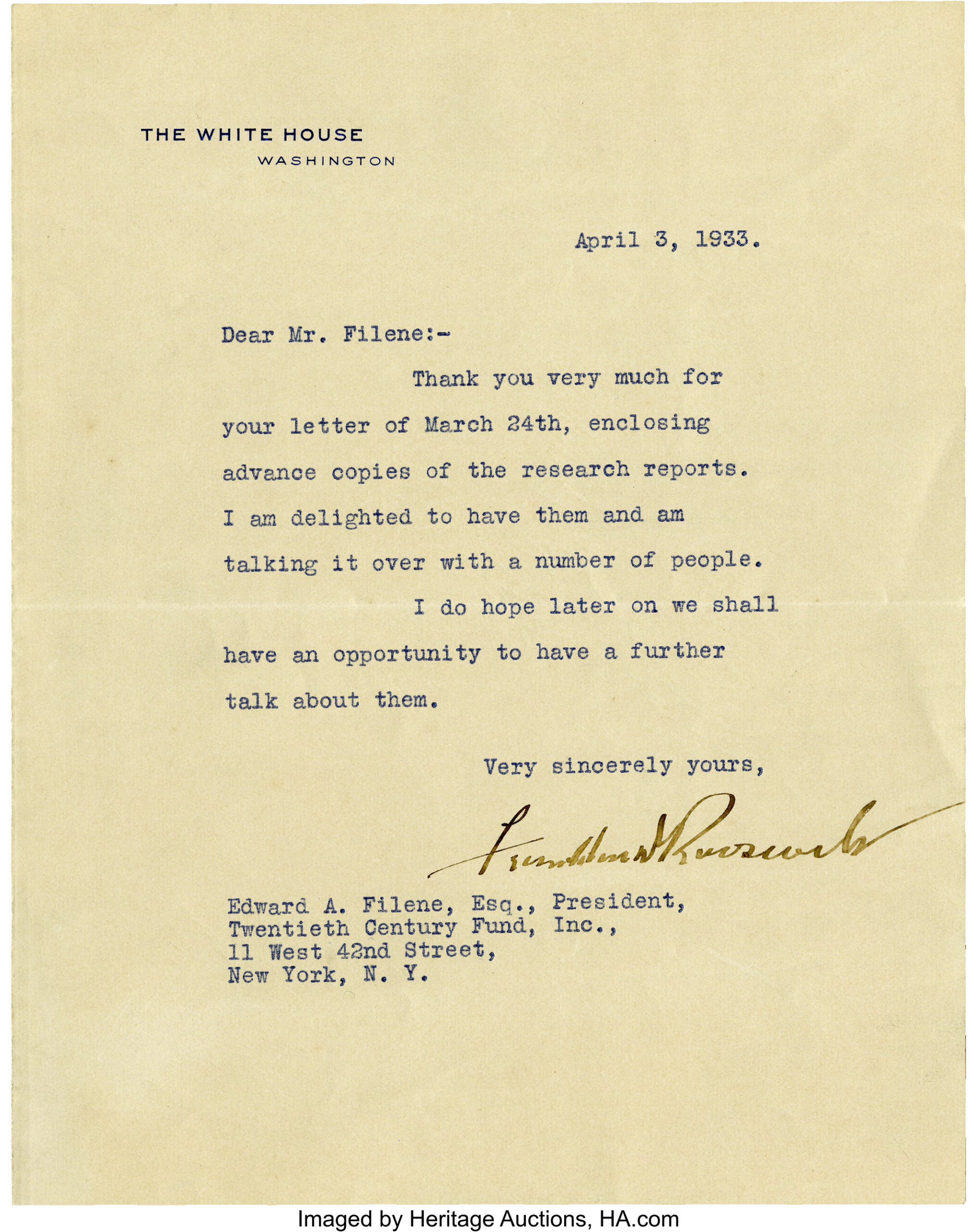
Roosevelt’s letter to Filene
With credit unions catching on like wildfire across the U.S., it was time for national recognition of the movement. In March of 1933, Filene wrote to President Frank D. Roosevelt on the matter, laying the groundwork for national legislation. In April of that same year, the president responded positively, letting Filene know he was seriously looking into the matter and was hoping to discuss it with him further (see image).
A little over a year later, on June 26, 1934, Roosevelt would sign the Federal Credit Union Act into law, a move that Bergengren would call, in a letter to Filene, “The greatest single step forward in the history of the credit union movement.”
That same year, in August, Filene and Bergengren would convene with fifty-two credit union delegates on the topic of starting a national organization. The meeting, which began on August 7th in Estes Park, Colorado, and would last for four days, resulted in the creation of the Credit Union National Association (CUNA) or what would one day become America’s Credit Unions. Again, the effort was mostly funded by Filene, who would be named president emeritus, while Bergengren would be the organization’s first director.
A legacy
At this point in his career, one might assume Filene had reached an “Alexander wept for there were no more worlds to conquer” type situation, but even well into his seventies, Filene kept up his credit union advocacy work. Though he was no longer at the forefront of the movement, Filene never stopped speaking on behalf of credit unions in his engagements and travels.
In 1937, at the age of 77, Edward Filene became ill and passed away while traveling though France. Though he has been gone for nearly 90 years, his work lives on in our industry today, cementing his legacy as the Father of U.S. Credit Unions.
Upon his passing, Franklin D. Roosevelt said, “It is not individual persons but the people as a whole who were closest to the heart of this unique personality. Mr. Filene was, however, more than a champion of popular rights. He was a prophet who perceived the true meaning of these changing times. He was an analyst who was able, by mathematical calculations, to make plain to us that our modern mechanism of abundance cannot be kept in operation unless the masses of our people are enabled to live abundantly.”
“His democracy was, therefore, more than a tradition. His liberalism was more than a formula. His faith was more than a mere assent to principles which have proved to be tried and true. He did not repudiate the past, after the fashion of some reformers, nor did he repudiate the future after the fashion of those who fear reform. He believed in learning and searching out the ways of human progress.”
Following Filene
While this tragically brings us to the end of this series, I hope the journey has been an education and inspirational one for all of you, just as Filene’s travels were for him, and serves as a reminder that we should all be “following Filene” in his passion and spirit for financial cooperatives.
Though all good journeys must come to an end, do not to fret, there’s more of Credit Union History Month to be had yet!


