









































“To live in this age, then, we must all have money. Unless the masses are amply equipped with money, the machinery of capitalism can no longer be kept in successful operation, and there is not only desolation and unemployment among the people but no profits for capitalists. The life and security of all America, therefore, now depends upon how money is used.” – Edward Filene.
The above quote comes from a speech Edward Filene gave to educators in his later years. The quote offers a viewpoint into how Filene saw the economic security of America and perhaps why he was so committed to the building of credit unions in the U.S. As a businessman, Filene knew that in modern times, businesses relied on the everyday American consumer—no longer the wealthy—to purchase goods and keep the economy going. After all, William Filene & Sons’ target demographic was middle-class women, and it was their “bargain basement” that offered the store economic security during the Depression. He had seen the spending power of the middle and lower classes firsthand.
But Filene also knew, after his travels in India and the Philippines, that without access to credit and trustworthy financial institutions, the poor had no means with which to access money and better their situations. He knew the powerful difference a community cooperative could make. And though, as we discussed last time, Filene’s attempts to help the villagers in the Philippines get their own financial cooperatives were all for naught, it would not be his last attempt to build what would later be called credit unions.
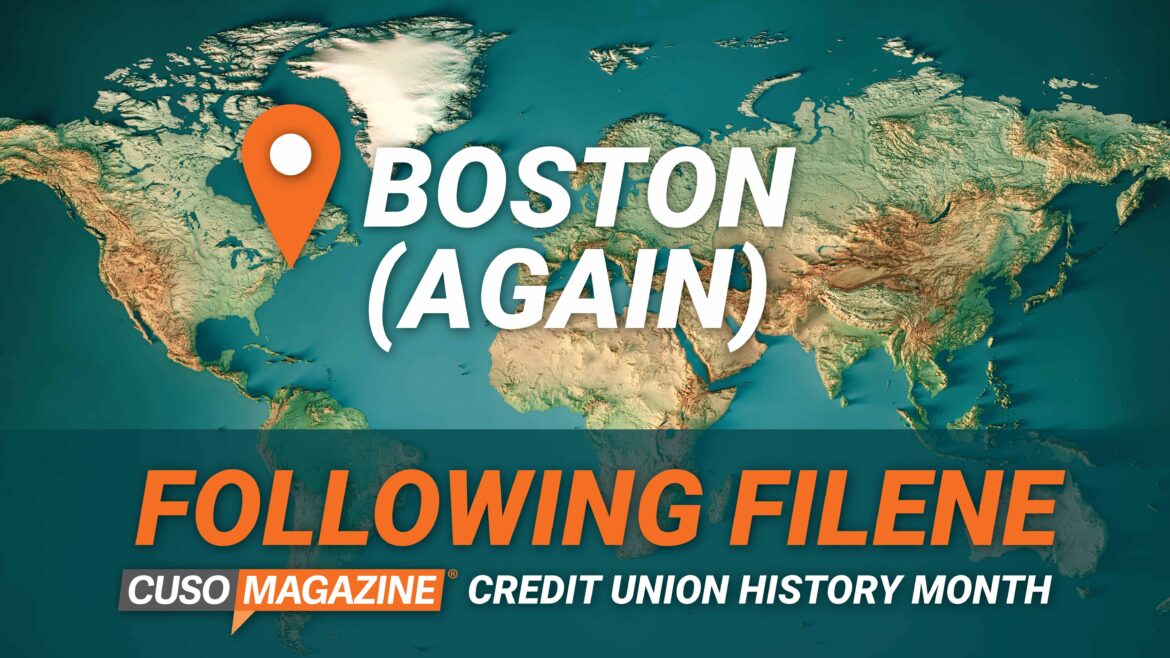
Travels complete and inspiration struck, we find ourselves back in Boston again, dear reader, but this time with a passion and knowledge of financial cooperatives in tow.
Credit unions take their first steps in the U.S.
Upon returning home, Filene would jump into credit union activism nearly right away, despite the fact that, at the time, he was still running William Filene & Sons and was just beginning to dip his toe into social activism. However, even with Filene playing an active role, the credit union movement would not gain momentum with him alone. While our main character is still, of course, Edward Filene, it’s time for us to introduce a few other characters you may have heard of, namely Alphonse Desjardins and Pierre Jay.
You see, Alphonse Dejardin was a French Canadian who, starting in the year 1900, began the “People’s Banks” in Quebec. These were the earliest examples of credit unions in North America, though they had yet to be called such. By 1914, Desjardins would start over 100 of these institutions, which would serve as the main inspiration and blueprint for U.S. credit unions. Desjardins’ early cooperatives caught the eye of American Pierre Jay, who invited Desjardins to America to collaborate on creating similar institutions in the U.S.
In 1908, just one year after his trip abroad, Filene began working with Jay to arrange hearings with the Committee on Banks and Banking of the Massachusetts legislature on credit unions. In February of 1909, Desjardins testified before the committee. Upon their recommendations, Edward Filene and Pierre Jay drafted the Massachusetts Credit Union Act, with input from Desjardins. Two months later, the bill became law, the first in the country to legalize the creation of credit unions. New York would follow four years later.
To the national stage and beyond
Following his successes with Pierre Jay, Edward Filene would soon become one of the biggest and most outspoken supporters of credit unions in the country. Thanks to the work of Jay, Filene, and Desjardins, credit unions would begin to thrive in Boston and New York. However, credit unions had yet to have national reach, something Filene was eager to correct.
In 1914, with the help of other businessmen, Filene would open the Massachusetts Credit Union Association, whose sole goal was to “disseminate information in respect to the benefits of credit unions…to organize credit unions…to make loans to credit unions…and to promote and assist credit unions,” all in an effort to support the creation of new credit unions throughout the country. Filene would also bring on a new partner, Ray Bergengren.
Filene and Bergengren would soon go on a nationwide credit union spree, the efforts of which would take the idea of credit unions from a very concentrated movement to a national one. But again, that’s a story for next week.


