














































“I have always thought that a business should rest upon a principle rather than upon a person.” – Edward Filene
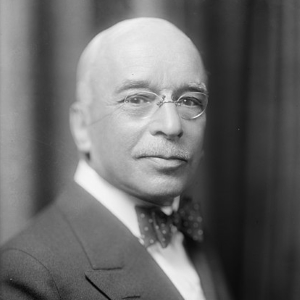
Edward Filene
Welcome, dear reader, to a new series for this year’s Credit Union History Month: Following Filene. As we travel back in time to the origins of our movement in the US, it’s only right that we take the time to highlight the “Father of U.S. Credit Unions,” Edward Filene.
Throughout this four-part series, we will be following Filene’s life journey around the world. From his start in Boston, to the inspiration he found in India, to his first foray into advocacy in the Philippines, to the founding of CUNA in Colorado, we’ll make sure to hit it all.
Our travels begin in Boston, Massachusetts (a location that will continue to be a main character in the credit union story throughout this series), the birthplace of Edward Filene. Though Filene would travel around the world and the U.S. throughout his life—so much so that he passed away while abroad—the root of his efforts always returned to his home city.
(Ironically, the one time in his childhood that Filene would leave Boston would be to travel to a boarding school in Germany—his parents’ homeland and the country where the first credit unions would be founded.)
But for now, those ventures are quite a ways off.
Kernels of cooperatives in Filene’s business ethics
As most of you probably know, Filene didn’t start out his career in cooperative finance, but rather, in his father, William Filene’s retail company, William Filene & Sons. The company specialized in women’s clothing and, under Edward’s and his brother Abraham’s guidance, became one of the largest retail stores in the world.
While working in women’s clothing retail may feel like a far cry from the credit union pioneer Filene would one day become, his ideals and cooperative values were very apparent during his time at William Filene & Sons. For starters, Edward and his brother introduced a series of welfare and benefits programs for the employees, many of which were quite revolutionary for the time (remembering this was a time before a legal minimum wage, the 40-hour work week, or regulated safety standards).
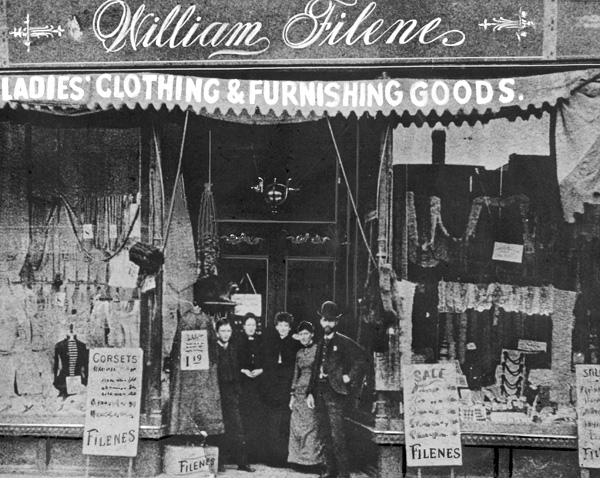
William Filene Storefront in 1881
These programs included “a welfare director position, hygiene classes, and savings and loans programs; [the company] set a minimum wage, offered insurance and sick pay benefits, created an employee library, and held weekly employee meetings where workers could air their concerns. Their store management also pioneered some of the country’s first welfare capitalism practices; these included a simple benefits system and recreational programs…Additionally, Filene’s instituted an employee training program that included courses in retailing, buying, and selling. The program offered a career ladder for any employee, male or female, who sought to take advantage of it.”
While it’s clear through the above programs alone how much Filene valued something, it was really his and Abraham’s ideas of “industrial democracy” that serve as the precursor to cooperatives. Under industrial democracy, employees were given a say in the running of the company and their working conditions. The idea was that if employees had a stake in the business, they would perform better.
To put theory into practice, the Filene brothers created the Filene Cooperative Association (FCA) in 1891 (over ten years before Edward would discover financial cooperatives), as a means for their employees to collectively bargain, discuss working conditions with management, and vote on policies through an employee council that consisted of 18 elected members. Through the FCA, the council could overturn store policies if it had two-thirds of a vote and overrule a veto by management with a unanimous vote.
Though the FCA rarely exercised its power, the ability for employees to openly challenge management without fear of retribution and have significant power over store policies was practically unheard of. And it’s in these early business choices that we can see the first kernels of the cooperative principles Filene would one day help write.
His care for his employees, his democratic approaches, and his cooperation and value for unions set him apart from other employers who chose to fight against unions and prioritized profit over people. In this way, Filene, much like credit unions themselves, held a people-helping-people approach to business, and prioritized the needs of the working class.
With ideals such as these, it’s no wonder Filene would be so inspired by the cooperatives he would one day come across, going so far as to bring them back to the US (though we’re not there in the story quite yet).
When one door closes…
Tragically for Filene (though, I suppose, good for credit unions), disputes with new management over these exact ideals and his ever-increasing time commitment to activism eventually led to Filene being stripped of power by the company’s board in 1928, placed in a figurehead role, and essentially removed from the business altogether.
His removal from the store, however, gave Filene more time to focus on his activism, which had always been a passion of his. Namely, he’d turn his eye to the budding credit union industry, a cause he’d been interested in since first encountering them decades ago and had been supporting since.
But again, we’re not yet at that point in the story. For now, it’s time for us to say goodbye to Boston, as we, like Filene, are going abroad. On the next stop of this journey, it’s time to travel to Calcutta, India, in the year 1907, where Edward Filene would first discover cooperative finance…


Rex H.#1
Really interesting article. Quite looking forward to parts 2, 3, and 4. Filene was a fascinating study of 20th century capitalism, actually.
Do kind of feel your site needs an ’email this’ link on your article pages, incidentally.