

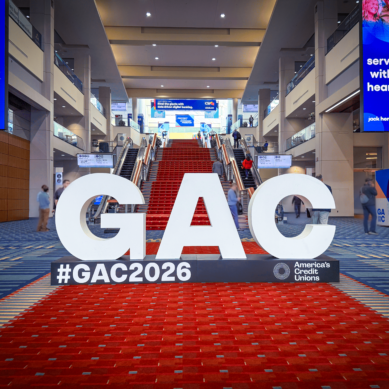











































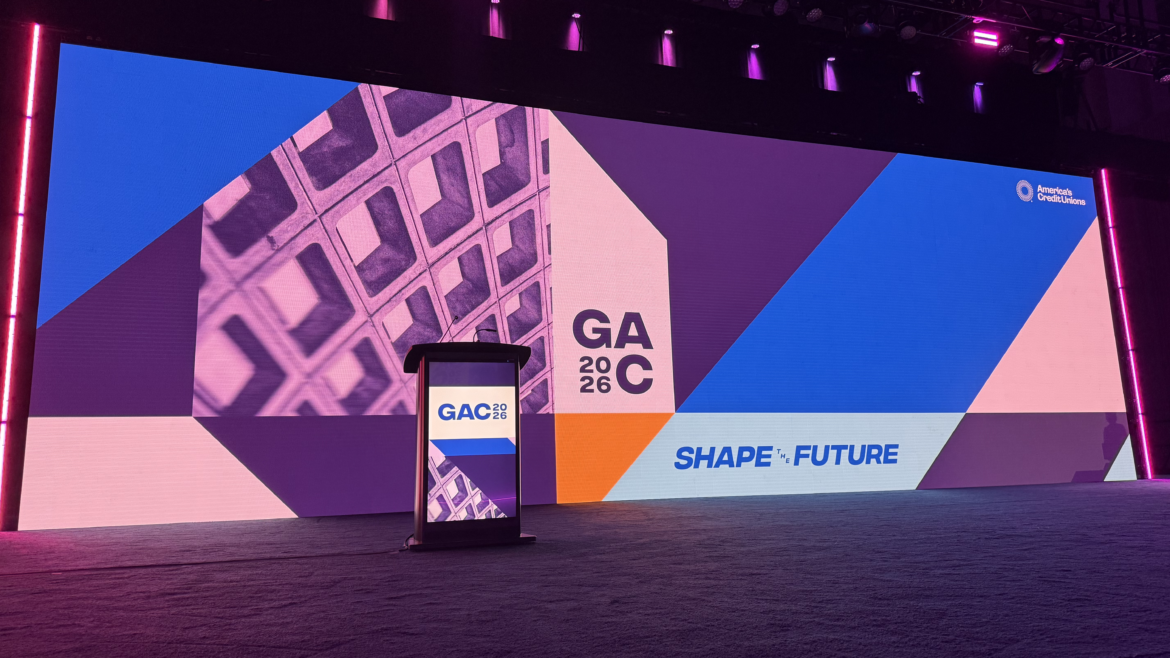
Good morning, and welcome back to our special series reporting on the 2026 Government Affairs Conference! While you are all reading this on a bright (and hopefully sunny) Wednesday morning, as of writing, it’s a rainy Tuesday for us here in D.C. Despite the gloomy weather, the energy in the nation’s capital is anything but, as thousands of credit union leaders collaborate and advocate.
Today marks day three, the final full day, of GAC. Filled with breakout sessions, Tuesday only had a single general session, but it consisted of a slew of fantastic speakers covering topics from AI to the economy to leadership to legislation and more. With no shortage of events to cover, let’s get started.
Updates from credit union organizations in D.C.
Up first on Tuesday’s agenda was a series of short but meaningful presentations from various groups representing credit unions and supporting their efforts nationwide.
To start, John Bratsakis, Chair of the American Association of Credit Union Leagues and President and CEO of Maryland/DC Credit Union Association, was joined on stage by all 31 credit union league and association leaders to discuss the advocacy work and impact of the leagues.
With 135,500 state bills reviewed for potential credit union impact, 7,300 state legislators in all 50 states engaged, and over 1,600 meetings with members of Congress in 2025 alone, the AACUL has been hard at work. But, as Bratsakis stressed, this work is not and cannot be merely done for credit unions; it must be done with them—their support, stories, and data—to bolster advocacy efforts.
“Your stories power our advocacy, demonstrating that credit unions are more than financial institutions. Credit unions are catalysts for financial well-being and opportunities,” said Bratsakis.
Next to the mainstage was Troy Stang, President and CEO of the GoWest Credit Union Association and Board Chair of the Credit Union House—the home base for credit unions in D.C. Those who read our series last year might remember Stang’s announcement of the Credit Union House Modernization plan. Well, Troy has returned to the GAC stage a year later, and on the 25th anniversary of the Credit Union House, to share an update on the work being done.
In the year since the announcement, the Credit Union House has raised approximately 80% ($11 million) of the $13.5 million needed to make the project a reality and is gearing up to break ground on the project—though Stang says he would like to see the plan fully funded before doing so. The hope, reports Stang, is to welcome credit union leaders into the newly revamped Credit Union House by this time next year.
Turning our attention to community giving, the next guest was Caroline Willard, Board Chair from Credit Unions for Kids, who offered some insight and impact on the organization’s efforts after decades of work. Celebrating Credit Unions for Kids’ 40th anniversary, Willard shared that since its inception, the organization has raised more than $225 million for local children’s hospitals throughout the country.
“This is about more than healthcare. The number one cause of financial hardship in the United States is medical expenses,” Willard noted. “When you support Credit Unions for Kids, you’re not just funding care, you’re protecting and strengthening communities. You’re living out your credit union mission.”
The final speaker from this group was Karen Harbin, Board Chair of America’s Credit Unions and Commonwealth Credit Union’s President and CEO. As part of the selection committee, Harbin had a hand in choosing Scott Simpson as the agency’s newest leader, and she expressed the thought process behind that selection.
“We selected [Simpson] not only for his more than 30 years in advocacy experience, but for his authenticity and his vision on where this movement could go. That vision is shared by me and the world, and we are excited to be moving forward together,” said Harbin.
“I can say with complete confidence that Scott is the right leader for our movement,” she continued. “His energy is refreshing, his passion for corporate finance is contagious, and his commitment to listening and learning from members is evident in everything he does.”
Following in the footsteps of speakers before her, Harbin also stressed the importance of continued and unified advocacy work, particularly in regard to the upcoming elections and supporting pro-credit union candidates on either side of the party lines. Harbin ended with a call to action for credit unions to go home and add their voice, passion, and expertise to the unified credit union message.
Economic outlook: tariffs, employment, and more
Hopping over to the economy, GAC’s next speaker was Dr. John C. Williams, President and CEO of the Federal Reserve Bank of New York. Williams provided insight on the current status of the US economy, its impact on consumers, and the outlook for the rest of the year.
On a macro, big-picture level, Williams noted that despite uncertainty around trade, the US economy has been resilient. Real GDP grew, and middle-class families feel secure economically. However, lower-income households are more financially constrained.
Tariffs, of course, have been a big focus over the last year, with many arguing about their effectiveness and consequences. According to Williams, the data is conclusive: overwhelmingly, the cost of tariffs been borne domestically, with most of the burden falling on US consumers, due to the impacted prices of goods. Williams estimates they have added .5-.75 percentage points to the current inflation rate.
However, once the peak effects of the tariffs are behind us, Williams predicts prices will drop, and believes that by 2027, inflation could return to the 2% target.
Following his economic report, Williams was joined on stage by James Akin, ACU’s Head of Regulatory Advocacy, for a brief Q&A.
Focusing on a hot topic at the moment—AI and the potential for job loss—Akin inquired as to how the Federal Reserve Bank incorporates AI considerations into output and labor markets.
Williams is confident that, despite fears, the growth of Artificial Intelligence does not signal the impending doom of the employment market or go so far as to cause structural unemployment. Likening the rise of AI to the rise of computers or the Internet, Williams remarked that while certain skills and tasks may be replaced by the technology, the potential for increased productivity as well as new ideas and business development will call for more workers.
“The best advice you can give anybody, whether they’re 18, 38, or 68, is to learn these tools…the important thing for our economy is that we fully reach our potential, that our labor force is able to use this new technology in an effective way,” said Williams.
Regarding the affordability crisis, Akin asked Williams to explain what role local financial institutions play in supporting resilience, to which he answered that, as local institutions, credit unions are better positioned than anyone to support families through economic hardships due to their community roots.
“One of credit unions’ superpowers is that you’re connected to your communities,” said Williams. “It’s the fact that you’re part of the community. You understand the local conditions, the economic challenges, and the opportunities.”
Finally, the two discussed the issue of market fragmentation, particularly with younger generations who often have several banking and finance relationships. “As that accelerates, how does the Fed think about implications for financial stability, consumer protection, financial health, etc.?” Atkin asked.
“The critical issue is: how do you evolve with this changing landscape in a way that makes sense for the value proposition of your organization? What is your value proposition? What do you do that you excel at? Know that, and make decisions accordingly. This change of neobanks and FinTechs is not going to go away, so the question is, how do you manage that?” Williams concluded.
Filene Research Institute shares strategic priorities for credit unions
Credit unions and the industry as a whole are currently dealing with a number of issues and concerns, many of which have come up during the conference this week. With so much to track and credit union leaders being told to “keep an eye” on this and that, how can they determine what is most critical?
Thankfully, the next speaker of the day came to help credit unions do just that. Christy Kimbell, Executive Vice President of the Filene Research Institute, revealed Filene’s ten strategic priorities for credit unions. This list was developed from the work the institute conducts with credit unions every day, with a goal of helping them know where to focus their energy.
While going through the list, Kimbell asked that credit unions assess which of these priorities they are doing well, which ones they aren’t, and how they can improve. Those ten were as follows (there is no significance to the order):
- Fighting fraud and maintaining trust: Very soon, fraud will be third largest economy in the world. It’s a business. The best way to navigate this, according to Kimbell, is to find strong strategic partners.
- Leveraging AI advances: Don’t adopt it just to have it; understand what you’re trying to accomplish before you deploy it.
- Attracting and retaining great people: “The talent market is feast and famine,” says Kimbell. “There are opportunities to get really strong people, but it’s difficult for specialized skillsets.” If you are trying to attract people, you want a fit for culture, and you want to have the younger generation working with you, so create benefits and offerings that work best for them.
- Optimizing FinTech partnerships: The strategic advantage of credit unions is in collaboration. Your partners should be pushing you to move forward faster and more effectively.
- Navigating the changing rate and regulatory environment.
- Expanding and deepening member relationships: The more personal and relevant, the more effective campaigns are. If you know how people spend their dollars, you know what they care about and, therefore, how to make marketing personal.
- Facing the evolution of payments and digital assets and the advent of stablecoin: Risk should be a strategic advantage. It shouldn’t be a reason to say no; it should be, how do we say yes, but in a safe and compliant way?
- Implementing a modern data strategy: As our organizations make decisions, we should be asking what data we are basing those decisions on.
- Differentiating and storytelling your brand and value to members: In a competitive landscape, what is your credit union’s value proposition and how do you deliver on it? Credit unions need to attract younger members, and to do so, they need to be in the right channels (social media) and be saying the right things.
- Pursuing the sale to succeed: “People are scaling for growth, but it’s not how big you are, it’s how effectively you engage with your members.”
Senator Pete Ricketts from Nebraska
Typically, GAC attendees get to hear from one or two pro-credit union members of Congress during the last few days of the conference, to gain some insight into what is top of mind for Congress as it relates to financial services before they go on their hill hikes. The first of this year’s lineup was Senator Pete Ricketts of Nebraska. Ricketts, formerly the governor of Nebraska, has served in the US Senate since 2023.
As a co-sponsor of both the Expanding Access to Lending Options Act and the Credit Union Board Modernization Act, Ricketts is considered a strong credit union ally in Congress. In his current role, Senator Ricketts serves on the Senate Banking Committee. As such, Ricketts’ message on Tuesday addressed some other key, credit-union-relevant pieces of legislation the committee is working on and how they will impact credit unions.
These include:
- The FIRM Act (of which Ricketts is a co-sponsor): This bill would eliminate reputational risk as a component of the supervision of depository institutions.
- Business Owners Protecting Act: This would eliminate unused authorities from the SEC that were created following the Dodd-Frank Act.
- The STREAMLINE Act (Ricketts is also a co-sponsor of this bill): Reducing regulatory burden by requiring updates to the threshold amounts applicable to certain currency transaction reports, such as suspicious activity reports. These thresholds, which were written in the 1970s, are outdated, the bill asserts.
- The Road to Housing Act (which was voted on just Monday night): This bill’s purpose is to “increase the supply of affordable housing in America” by reducing red tape to generate more housing stock and lower prices.
- The Clarity Act: This act would develop a regulatory framework for digital assets. Ricketts mentioned the Senate is still working with crypto companies to develop the final rules.
Finally, Ricketts mentioned an unnamed bill that is currently being developed by the Banking Committee that will direct federal banking regulators to come up with concrete steps to help small towns and rural communities with the formation of community banks and credit unions.
“Thank you very much for all that you do for Americans across this country, the service you provide, helping them achieve their dreams. What you do is very important. It is part of what continues to make our country great and what continues to grow our nation,” Ricketts concluded.
Adam Grant: Hidden Potential
In standard fashion, the last speaker of the day was reserved for the Ed Talk. Presenting on the topic of changing your mindset was today’s Ed Talk speaker, Adam Grant. Grant is a New York Times best-selling author of six books, a professor at the Wharton School, a TED speaker, and was named the number two most influential management thinker in the world.
Grant’s thesis focused on the idea of discovering hidden potential by changing your mindset. Essentially, while working with leaders, Grant witnessed leaders who were “good at thinking, but too slow at rethinking—they didn’t question their assumptions until it was too late.” By making assumptions about things that were once true but have become false over time, we miss potential and opportunity.
Missing potential can be devastating in the business world. We’ve all heard stories of ideas that were laughed out of meeting rooms, only to find out those businesses would go on to be Netflix, Amazon, or, in Grant’s personal missed potential story, Warby Parker.
Those leaders made assumptions about things that were once true (buying clothing over the internet is impractical, sending rental DVDs to people’s homes will never work, etc.), and failed to rethink and reassess. Had they, they would have realized those assumptions, while true at one point, had now become false.
This idea of being slow to rethink and challenge our mindsets has been the focus of many conversations here at GAC, as speakers on the mainstage, in breakout sessions, and in vendor discussions have urged credit unions to step outside “we’ve always done it this way,” and reexamine their mindsets and methods, both when it comes to leadership and adopting technologies at faster speeds.
“The world is changing faster and faster, and we need to get faster at questioning our assumptions so we can unlock potential in our teams, ourselves, and our organizations.”
To begin changing your mindset and developing the habit of rethinking, you must build a network of what Grant calls “disagreeable givers,” people who won’t simply tell you what you want to hear to be nice, but who have the courage to tell you unpleasant truths.
“The most valuable people in your network are the disagreeable givers who will give you the feedback you need and ask questions. We need to value them instead of writing them off. The more candid they are, the more you know they’re trying to help you grow,” said Grant.
Second, focus on building psychological safety in your credit union—essentially, create a culture where people can give feedback without fear. Ask your teams for feedback and criticism, but make sure they know you mean it and can handle it! Then, turn those critics who provided you with feedback into coaches by seeking their advice. Feedback is great, but it’s backward-facing, while advice is forward-facing and will help you improve in the future.
By challenging our assumptions and rethinking how we approach things, we can uncover that hidden potential, says Grant. “Ultimately, rethinking the way we’ve always done it is a skillset, but it depends on a mindset.”
The end is near!
If you can believe it, tomorrow is already the last day of the 2026 Governmental Affairs Conference! But don’t expect the day to be any less eventful. Wednesday promises to be a busy morning, with scheduled appearances from Congressman Juan Ciscomani (R-AZ), Senator Lisa Blunt Rochester (D-DE), and Senator Andy Kim (D-NJ), as well as a Young Professionals panel and one last Ed Talk.
Be there or be square!


