

















































Festivities began with the flag procession, in which each state flag is carried down the aisle by its credit union league members. These representatives always have a great time with the event, donning fun costumes, sports gear from their home team, or props. Wisconsin even tossed cheese curds from back home into the audience (don’t worry, they were kept cold during travel).
For others, the flag procession was the opportunity to make a statement. Members from Illinois, for example, carried signs stating “Repeal IFPA.” The IFPA, or Illinois Interchange Fee Prohibition Act, is a recent state law that banned interchange fees on taxes and tips.
While credit unions always make it a lively time, there’s a real significance behind the flag procession. “The flag bearers and their flags represent the commitment that all of us have to building a better world for credit unions and the members that we serve every single day,” said host Mia Vista Perez.
Afterward, the color guard marched its way to the stage, where the National Anthem was performed by Tricia Rhodes, followed by a recitation of the Pledge of Allegiance, led by the President and CEO of Frontwave Credit Union, Bill Birnie, concluding the ceremony. And just like that, the 2026 Governmental Affairs Conference was officially underway!
New ACU CEO, Scott Simpson, takes the stage at his first GAC
While GAC itself is officially in its 51st year, this is only the third year it has been hosted by America’s Credit Unions and, notably, the very first year with ACU’s new President and CEO Scott Simpson at the helm (though his 22nd as an attendee). While former President and CEO Jim Nussle’s specific brand of enthusiasm will be dearly missed at the festivities this year, everyone has been quite eager to see what Simpson would bring to the table—or stage, rather.
Simpson made his first appearance on the mainstage Monday morning and was met with a standing ovation from the crowd. Sharing some of his personal history with credit unions, Simpson did not recount his work experience, but the story of when his father-in-law, a blue-collar worker, discovered his seven-year-old daughter had ovarian cancer—the same type of cancer Simpson’s own daughter would later be diagnosed with.
Struggling to figure out how to provide for his family and his daughter’s medical needs during this crisis, Simpson’s father-in-law was at a loss until his manager, a volunteer board member at Federal Employees’ Credit Union, took him by the hand and walked him into a credit union so they could work together to figure out how to care for his daughter.
“That single story, a generation ago, my family will never forget,” Simpson professed, tearing up. “Do you believe in miracles? For me, the answer is yes, I believe in miracles.”
Delving more into the year’s theme of Shape the Future: Protecting the Path to Economic Freedom, Simpson remarked on the need, now more than ever—especially as “affordability” becomes a buzzword for politicians—to make it clear that credit unions are the solution to the affordability problem.
“I’ll declare this as boldly as I can,” said Simpson. “Right there, alongside political freedom and religious freedom, is economic freedom. The right to rise through effort and merit is one of the fundamental pursuits of happiness in this country. And if you try to quantify it, if you look over the arc of our history, the number of lives that have been touched because credit unions exist, it is one of the greatest social movements in the history of our country and therefore in the history of humanity.”
In order to protect that path to economic freedom, our industry must, according to Simpson, “industrialize, accelerate, and amplify the capture and retelling of these credit union stories.”
The importance of storytelling was touched on last year and in yesterday’s Ed Talk from Kendra Hall, but it’s clear that the need for powerful, strong storytelling advocacy work will be a key theme at this year’s GAC, not just to support credit union leaders going to hill hikes, but as a call to action for credit unions (that means you, reader) long after the conference ends.
“As a unified movement, all of us must have the discipline and the wisdom to see that this model is under constant threat, and we must have the discipline and wisdom to stay together…That’s where the strength of our political machinery is crucial, and it’s why the organizational imperative of America’s Credit Unions is government advocacy. Everything we do, everything else will be put through that lens, because if the government doesn’t permit credit unions to exist, they don’t get to exist.”
In his closing words, Simpson reminded the credit union leaders present that while the networking, “pomp, and parties” of the week are a great time, there’s a reason GAC is hosted in D.C., and that is so credit union leaders can bring their stories and their members’ needs to policymakers, and that should remain the focus of the event.
“Please use your voice for your members this week…This is your moment to remind policymakers that [the credit union] difference is everything to our members. I am honored to stand shoulder to shoulder with you in this cause.”
Greg Inman Servant Leadership Award
Another annual tradition at GAC is the presentation of the Greg Inman Servant Leadership award. Greg Inman, a credit union champion and Chief Operations Officer of Neighbors Federal Credit Union, was the pinnacle of all that credit union leaders should be. Greg passed away in 2021, leaving behind a legacy of selflessness and a devotion to the credit union mission.
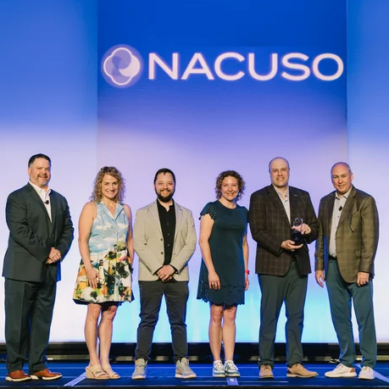
This distinction, given in honor of him, is awarded to a credit union leader who embodies a servant’s heart. This year, the Greg Inman Servant Leadership Award was presented to Nader Moghaddam, President and CEO of Financial Partners Credit Union. Moghaddam has served the credit union industry on local, state, and national levels for over 27 years.
Known for his kind heart and love for his community, Moghaddam has made tireless efforts to ensure the credit union is invested in its community and committed to giving back. Under Moghaddam’s leadership, Financial Partners Credit Union has partnered with Columbia Memorial Space Center since 2009, investing in and supporting their learning center, which sees over 100,000 kids each year. Additionally, Financial Partners also started a program to support girls in STEM, one of the only of its kind in the L.A. area.
“It is a true honor to receive an award that carries [Greg’s] inspirational weight,” said Moghaddam. “I accept this recognition, not as an individual achievement, but as a reflection of the extraordinary people I’ve had the privilege of serving with over the years.”
“In the credit union movement, leadership has never been about titles or authority. It’s about responsibility, trust, and service,” he continued. “Being a servant leader means listening first, collaborating openly, and creating a condition for others to succeed, including our teams, our members, and our communities.”
On a final note before leaving the stage, Moghaddam applauded Simpson and the decision for him to lead the organization. “We are so fortunate to have Scott Simpson at the helm. I’ve had the pleasure of working with him, and it’s a true honor and a true pleasure to have someone who cares so much about our industry, who is so wise, who is so kind, and who is so focused, lead us forward.”
Brené Brown on daring leadership
With that, Simpson acquised the stage to the days “Ed Talk” speaker, Brené Brown, author of Dare to Lead. In her opening, Brown shared her journey recovering from a sports injury. The injury, her doctor claimed, was a compensatory one, meaning she was injured because she was using the wrong muscles.
Credit unions, in the face of poor leadership, can suffer from compensatory injuries. “By not using efficient skill sets and mindsets, we’re using ineffective muscle groups,” Brown claims. “We are building on dysfunction.”
To avoid using those ineffective muscle groups, credit unions need to strengthen their core. In other words, their leadership. But how do credit unions build that leadership muscle?
Good leadership, Brown states, comes from vulnerability. And within that vulnerability is courage. One cannot be courageous without first being vulnerable, Brown insists, for “vulnerability is the birthplace of courage. It is an emotion we experience from uncertainty, risk, and exposure.”
For leaders, vulnerability can often involve admitting when something is unknown to them. This can be a challenge, especially for senior leaders who believe their value comes from their knowledge.
“Your value is your subject matter expertise, but also you need to be open to what you do not know,” Brown said. “The person who says ‘I have deep experience, but I’m also open to everything that I do not know,’ that’s the most valued leader in any company.”
Kyle Huaptman on mergers, NCUA, and more
Monday’s afternoon sessions kicked off with a fireside chat between NCUA Board Chairman Kyle Hauptman and Scott Simpson. Readers who caught yesterday’s special report know that Hauptman was also present at the Underground Sunday morning, discussing the future of the NCUA. Today’s presentation covered much of that same ground, but also ventured into new territory.
When asked about his status as the NCUA’s lone board member and his candid opinion on that, Hauptman cited previous instances, including Dennis Dollar and JoAnn Johnson, where one member not only operated the board alone, but also conducted rulemaking that’s still on the books.
Though yesterday Hauptman hinted that his successor would be announced soon, he was more vague on the timeline today, simply stating, “I’ll be around till I’m not.”
Regarding the elephant in the room—the firings of his two colleagues and their subsequent lawsuit—Hauptman stated to have no knowledge of the litigation’s status or how the courts might rule, commenting that he doesn’t pay it much attention as it’s outside of his control and that he’s just keeping his head down and doing his job.
“At some point, there will be other board members,” said Hauptman. “Congress says it’s a three-member board, and at some point, there will be.”
When asked about his time and accomplishments at the NCUA, Hauptman said he was proud of his time there, stating he came in with three goals, accomplishing two of them and achieving progress on the third—making the de novo process easier—though not as much as he would have liked.
Mainly, though, Hauptman emphasized his pride that in a time of pushback, NCUA was the only financial regulator in favor of digital assets and blockchain, as well as the spring cleaning and deregulation work of late—a feat which both Simpson and the room as a whole thanked him enthusiastically for.
“We are grateful for the focus, for the recognition of the crushing weight of the regulatory activism we have felt over time,” remarked Simpson. When asked if there would be more deregulation on the horizon, Hauptman noted that while there is more to come, there are currently 24 regulations open for comment, and encouraged credit unions to respond to those.
Simpson then brought the conversation over to mergers, a very controversial topic in the industry over the last few years. In response to Simpson’s asking for his viewpoint on mega mergers, Hauptman couldn’t help but tease the irony of the question, considering America’s Credit Unions only existed as a result of such a merger.
“I’ve been to four of these now in person—this convention you have. During the first two, it was called CUNA GAC,” Hauptman replied. “Anyway, you were saying something about mega mergers?”
On a more serious note, Hauptman, instead of criticizing such mergers, praised the USA for its uniqueness in the diversity of financial institutions it offers. While the industry often feels nervous about the dwindling number of credit unions, our country still boasts over 8,000 depository institutions, Hauptman stressed. Canada, by comparison, only offers six. Australia, four.
He did, however, agree that mergers and the absorption of smaller credit unions into larger ones dull the credit union magic a touch and that once these institutions are gone, they are gone forever.
America’s Credit Unions advocacy panel
The final component of the day was a two-part panel presentation featuring leaders from America’s Credit Unions advocacy team, including Greg Mesack, Senior VP Advocacy, Ann Petros, VP of Policy Engagement and Credit Union Operations, and James Akin, Head of Regulatory Advocacy.
The panel, which continued building the key focus for the week: the need for strong storytelling to boost advocacy efforts and impact change in D.C., was led by Meghan Burris Small, ACU’s Chief Communications and Marketing Officer.
The panelists shared their expertise on making the most of meetings in Washington and sharing how credit union advocates can stand out and secure victories in the face of strong opposition. On the subject of said opposition, panelists were asked how credit unions can beat their very well-funded competition.
“Is advocacy a dollars game or a precision game?” Small asked.
Mesack denied that it was either, but rather a “what’s your strength game” instead. While the strength of banks may be money, for credit unions, the strength is in our numbers. The number of credit union advocates and credit union members who are speaking out to tell their stories.
“Bankers write checks because they don’t have anything else,” said Mesack. “Credit unions have people, a mission, a story, and grassroots. At the end of the day, if it comes down to big banks writing another check versus thousands of credit unions across the country coming together with their members—telling their stories of what those credit unions do to make their lives better, what credit unions mean to their communities—that can match money systems.”
In the latter half of the discussion, three new panelists—Emily Leite, Chief Advocacy Officer of the Ohio Credit Union League, Amy Brodersen, President/CEO of Family Focus Federal Credit Union, and Erin Moore VP of Government Relations at OnPoint Community Credit Union—joined the conversation.
From here, the discussion shifted towards the importance of advocacy and having a unified voice in regard to the work being done in credit unions back home.
“Simply put, coordination makes our efforts more powerful,” said Moore, when asked about the effect of a coordinated advocacy strategy. “It helps us build a stronger case, and it builds trust, and trust is what sustains advocacy.”
Brodersen, coming from a small credit union, commented that while small credit unions and large credit unions may have their differences, “we all share the same last name.” Regardless of whether your credit union is $10 million or $10 billion in assets, Brodersen emphasized the importance of showing up, speaking out, and ensuring we have a seat at the table.
“We show up for [our members],” Brodersen added. “Because if we don’t show up, they don’t have a voice. We can’t sit it out, we need to be at the table.”
Looking to day three
With that, activities for day two concluded, as attendees broke away for their afternoon breakout sessions—don’t worry, we’ll cover those later—and to peruse the exhibit hall some more. That also means that’s it from us for today, and thank goodness, because any more and this article would have been too long to publish!
We’ll be back first thing tomorrow morning for the third and final full day of the 2026 Governmental Affairs Conference. Featuring a jam-packed lineup of speakers, including Senator Pete Ricketts of Nebraska, Dr. John C. Williams, President and CEO of the Federal Reserve Bank of New York, and TED Talk speaker Adam Grant, the day is not one to be missed.
Of course, we’ll be covering the day’s events to make sure you’re in the know on everything going on in D.C. this week, so make sure to keep your eyes peeled for our next special report! See you there!


