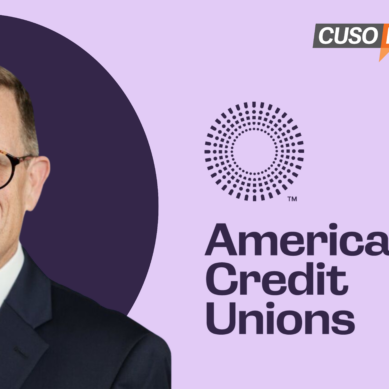


















































CUSO Magazine: Hi Scott, thanks so much for meeting with us today!
Scott Simpson: Glad to be here.
To start things off, you served as President and CEO of the Utah Credit Union Association for over twenty years, in addition to another year working in the same capacity for the California and Nevada league. What lessons and experiences did you gain during your time with the leagues that you have brought into your new role at America’s Credit Unions?
Advocating on behalf of cooperative financial institutions and protecting them from the engagement of those who are devoted to the destruction of this business model. That’s what I’ve carried with me and gained in 22 years: the relentless desire on the part of the for-profit sector to eliminate competition through policy. So, I’m a political kind of policy hack.
The other part that is deep in my bones now is just an absolute devotion to the cause. There are personal stories in my family that are significant. Our family was blessed and helped because a cooperative—a credit union—was there. And for 20 years I’ve had a front row seat to many, many stories. So, that’s what keeps the fire lit for me; I get to wake up every day and use the skills that I have to defend the right for people to pursue economic freedom in their lives, their way.
Absolutely. I feel like I hear that from a lot of people in the industry, that they got interested in it because there was a cooperative there when they needed it most. Do you feel like that’s what led you to join the leagues originally?
Basically, I was a pissed-off credit union member. In Utah, we’ve had high-intensity bank vs. credit union legislative fights. I was hired in the middle of it. As I said, I was a political and policy professional, but I was also a credit union member. Our family relied on our credit union, especially in the early days of our marriage. I watched the legislative fight begin to unfold, and I was irritated by that.
Eventually, the time came for Utah credit unions to intensify the defense of credit unions, and they asked if I would consider coming to work for them. I jumped in, not thinking that this would transform my professional career for the rest of my life. Political folks, we have short attention spans and a history of resetting every two years. There are a lot of on-ramps and off-ramps that happen in this world. That’s kind of what I had anticipated, that I would do this for a minute and then the next train would come by.
But, after a minute, I’m thinking, “Wait, this is a cause I can sleep at night knowing I’m defending.” The more I did it, the more I talked about it, and the more I heard and witnessed transformation occur in people’s lives, because there was an alternative to banks in the marketplace…I went all in. I just became a believer.
Now here you are decades later, still on the train.
Still on the train.
I think that speaks highly to the industry. So, you’re settling into the role pretty well. Looking forward…
I’m not sure I would use “settled” to describe it.
No? How do you feel?
Well, I’m in the role. But there’s an unsettling. It is intense. 4,100 members. Think about that. There are 145 million people whose life savings are being cared for by our 4,100 credit unions. They are using this business model to extend opportunity to one another.
But we have this unbelievably well-resourced opposition that is devoted to disrupting this idea of a credit union, and that causes intensity amongst our credit unions to live in this highly-regulated industry, in a politically charged environment, with all the technology in the marketplace, all happening around them every day. That intensity sometimes finds its way focused on us and our role.
That urgency is what we feel every day in our jobs. So, we are in the role, but settled? I’m not convinced that’s ever going to happen.
Well, as you start to learn the role, what are your hopes and goals for the future?
Our hope is to defend and protect the environment so that credit unions can thrive. We have 145 million Americans who are part of this, but that’s only a third of the country. I’m convinced that the intent at the beginning of our movement was to allow this opportunity for the masses of the country.
The banks use this kind of pinhole revisionist view of that history to say, ” You were only created to serve the poor.” They use the term “modest means” in the Federal Credit Union Act, but think about 1934 America…that was almost everybody. And I feel like everyone should have that choice placed in front of them to pursue their happiness and economic freedom.
So that’s what I hope for—that we can manage that environment so that it can thrive and then try to find a way to grow it, because this is not just a business. It is foundational to the guiding philosophies of this country. Freedom. There are all kinds of freedoms. Political, religious, and economic freedom. And that’s why people came here. Think about all the settling that has occurred in this country. We all have ancestry that made a decision to go somewhere. They were pursuing freedom. It sounds like a lot of apple pie, but it’s the stuff of who we are.
I think about Ed Filene. He had this idea. The man was a merchant, and he was wealthy, but he had this appreciation that even his own employees couldn’t afford to consume because they couldn’t absorb the costs. They didn’t have access to credit. It’s a brilliant idea. Unbelievable. Its execution in the U.S. is unmatched. But it’s in the face of unbelievable opposition. They really never stop trying.
Speaking of that opposition, just last week, America’s Credit Unions announced its nationwide campaign against the Durbin-Marshall credit card mandates. Why does this bill stand out as a priority for the organization?
The President of the United States.
The President is sensitive to the affordability struggles in our country. He promised during his campaign that he would address credit card rates and other things, all in pursuit of affordability. It’s something we’re absolutely sensitive to. We share the ambition, but this heavy-handedness is what actually ends up harming consumers. I think the White House has come to put their arms around that as well; that the heavy-handed, top-down, price control sort of approach to this will end up harming the people that they want to help.
Our existence in the payment space—the fact that a not-for-profit provider is in this space—is so much closer to the President’s aspirations. We are really the solution in the marketplace already. We just need to point America to a credit union.
So that’s why it’s on the agenda. We have been dealing with that in the state legislatures in particular recently. It’s a constant drumbeat in Washington, but we’ve approached it from a maintenance perspective because most of the policymakers had taken their positions on it. The calculation changed a little bit in January when the President just threw that out as a “what about this,” and we’ve had to kind of race to that and elevate the priority.
Changing gears a little, talking about the NCUA. The NCUA has been operating with one board member for nearly a year now. How does America’s Credit Unions feel about the current trajectory of the regulator, and what do you hope to see happen there in the coming year?
Well, I think using the immediate rearview mirror to look at what’s happened, in spite of the fact that it’s a single-member board, look at the productivity that has happened and regulatory relief that has come using the authority that he does have, the opportunity that he does have. I think that’s been outstanding.
But, of course, we want predictability. Financial industries tend to thrive when there’s predictability, and having a full-functioning agency is needed for that—and that’s not exclusive to the board composition. The whole agency has had a fair number of churn in its employee ranks.
So, finding and establishing a full complement of our regulatory agency is certainly our objective, but I think most of our industry and our trade association would look at the work that this single-member board is doing as not insignificant. And while I think that change was also anxiety-inducing to the industry—not knowing what that transition might look like—I do think we’ve seen the ability to continue to function. The agency has done a yeoman’s work trying to advance what they can advance, and to keep the machinery moving in the face of some of this organizational challenge. It feels like we’re still cooking with gas, right? The industry continues to move.
This is your 22nd GAC, but your first at the helm. As such, what have you most looked forward to? How do you feel the conference has changed over time?
For starters, it’s substantially larger. It is just as passionate. I think it’s just as important. The political environment has transformed a fair amount, and as such, I think there’s an expectation or requirement for us to engage at a much higher level, at an intensity that 22 or 23 years ago was just different. It’s a different landscape.
But it’s also the gathering of the family. This is the one place you can get a sense of the breadth of this movement. We have about 6,100 attendees this year. It’s a record, and everything about this conference is like we’ve leveled up. We’re estimating that about 25% of our membership by institution is here. That’s incredible. That’s an amazing number of our credit unions that are here, and just to be able to see that is fire. To be a part of it is humbling. It’s inspiring. It is, as a political practitioner, it is a tool set that people wish they had.
That’s what I’m looking forward to, the wave that is going to generate from all of this—to be able to ride that, for all of us to get on and go… it’s going to be awesome.
For credit union leaders back home, how can they engage in grassroots advocacy work to help support the work being done here on the national level?
Well, there’s actually grassroots engagement going on while GAC is ongoing. Our team is reaching out to the folks in the industry that aren’t attending here and asking them to add their voice to the chorus, so there’s definitely an opportunity for people to weigh in in real time alongside those that are hiking the hill, which is great.
But for advocacy back home, the first and most important thing is executing on their own footprint—that’s the best thing. A credit union’s brand equity in the marketplace is the most powerful political weapon we have. It is the juice that our lawmakers react to, right? Because they don’t react to a national trade organization. I worked for a member of the U.S. Senate. He knew there was a national trade association, but what he cared about was what his credit unions felt back home.
That’s the way. In your backyard, show up. Hold a town hall meeting. Invite the members to come. They’ll come. They want that. They want the engagement in Main Street America, and we are that. We are the community-based financial institution of the future for this country, and so take up that baton and convene lawmakers in your space at home. That is the most powerful thing we have.
Throughout GAC, you’ve discussed the need for credit unions to share their stories. Can you talk about storytelling as a powerful tool for advocacy work?
Part of what our antagonists are trying to do is to institutionalize credit unions, to turn us into institutions as opposed to cooperatives that we are. So, ensuring that we are capturing the humanity of what we do every day is critical.
One of the concerns that I have is that the transformational experience that this business model delivers in our branches every day is just being lost in the transactional work that we do—just going out our door on a Thursday because that’s what we do. But in the life of that member, they’ve got the loan for their food truck. It’s a generational impact moment.
It could be a home equity line of credit. It could be a credit card. It could be an overdraft protection that allows a mom to put gas in their car. It could be that they don’t have to make the choice between gas and groceries. All of that stuff, we need to capture the humanity of it, not just the metrics, but the humanity of it. That’s the storytelling we’re talking about.
We need to industrialize, capture, and retell it with those human stories. And bring it not just to Capitol Hill, but everywhere. That is what makes us different. That is the essence of a cooperative.
Last question. Before we started the interview, you mentioned that you lived in Japan for a time. What was your favorite part about living in Japan, and what food do you recommend the most?
Almost everything. I loved everything about Japan. You know, the language itself has two irregular verbs. To do and to come. Those two words are irregular. Everything else follows the rules perfectly. Everything else is mathematics. It’s like the conjugation. It’s formulaic. And so I love the beauty of the language.
As for food, my favorite meal was beef sukiyaki, a family roast beef and potatoes dinner in Japan. It’s got tofu and vegetables, all kinds of stuff, and it stews in this soy, brown sugar water that’s so good. Then you dip it in a raw egg before you eat it. Incredible.
Thanks so much for your time, Scott! We cannot wait to see what’s next for you and America’s Credit Unions.

