













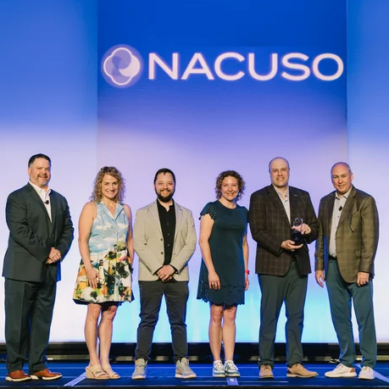

































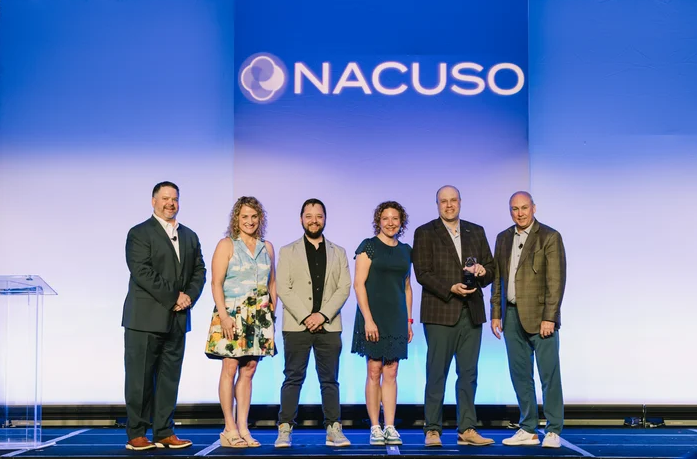
CUSO Magazine sat down with Nick Olexa, President & CEO of Storyfi, a visual media company specializing in sharing credit union stories and experiences, fresh off being honored as New CUSO of the Year at the 2026 NACUSO Reimagine Conference.
CUSO Magazine: Thanks for meeting with us, Nick! Before we get to know about Storyfi, we’d like to know a little more about you. Would you mind sharing your story about how you got started in the credit union space?
Nick Olexa: Post college graduation, I interviewed at a bunch of places and one of the places that I interviewed at was called CU Village. They were the original service corporation of the Michigan Credit Union League.
I ended up taking a job elsewhere, but quickly realized that the job that they talked about and advertised was not the job that I was working. So, I sent an email back to CU Village saying, “Hey, if that opportunity is still available, I would still be interested.”
The job was still open and ultimately became a job offer. It was a good move because I was with the Michigan Credit Union League family of companies for 16 years. It was quite a journey throughout the organization and in the last seven years I was there I held VP of Marketing and Communication roles across organizations.
How did that then lead into Storyfi getting started?
Storyfi was really born out of a business unit we developed internally. In late 2008, early 2009 we started a product called CUBE TV, which stood for Credit Union Broadcast Experience TV. It was a portal of content that we sold to leagues across the country for their membership. Things like weekly financial reports, what’s going on in the financial services industry, special reporting from big events like GAC, compliance and education, etc.
We produced that for three years and found modest success with it. It was never a big money maker for the league or CU Village at the time. CUBE TV was innovative for its time and perhaps a bit ahead of the market. We were early adopters of video technology, launching only three years after YouTube started.
We were trying to figure out how to take the resources we had built internally and make them more useful. We pivoted the team that serviced the product into supporting wider media initiatives. We were doing that for a fairly short period of time before credit unions in the state of Michigan started approaching us and saying, “We know you have video services that you use for yourself. Is that something that we could make use of?”
So we turned the business into an externally focused business unit that supported credit unions with their media initiatives.
The COVID years were hard. We had to find a way to pivot yet again through those. We took our mountain of content created turnkey videos that credit unions could put their logo and contact info on, which kept us in business.
CUBE TV had a very successful run up through 2023 as a business unit of CU Solutions Group and that is ultimately why the consortium of credit unions that founded Storyfi acquired CUBE TV to serve as the base of Storyfi.
They brought me over to run the organization and since then we have approximately doubled the size of the team and significantly increased the work we are taking in.
You were recently honored at NACUSO’s Reimagine 2026 Conference with the New CUSO of the Year award. What did that mean for you and the company?
Frankly we were a bit surprised! When we were named a finalist, I thought “well that’s nice to be a finalist! And I’m sure that’s where it ends.”
I didn’t think it would advance beyond that because it’s a competitive landscape—there are a lot of exciting solutions and CUSOs out there that are bringing value to credit unions. I was honored just to know that we were in good company.
A week before the event we got the email saying we had won, which still today hasn’t really taken hold in my brain to be honored like that. When you look at the landscape of CUSOs it’s certainly an honor to be recognized among them. It’s a testament to the work that my team does. Storyfi is a passion project and to have that passion recognized by NACUSO is humbling.
Why would you say video is so important to a credit union’s overall marketing strategy?
It’s one of the biggest gaps that we see in terms of what a marketing team can offer.
We work with a fair number of credit unions that have roughly a billion in assets and we see marketing teams even at that size that are incapable of doing video in-house. Often, they send it to an agency of record, who likely doesn’t have that capability in-house, and are subcontracting it out at a markup. We thought we could do it better, and more affordably.
Frankly, credit unions should be posting some sort of video content or media-rich content at least three times a week on their social channels to feed the algorithm, keep them top of mind.
But video marketing is more than just social media clips, though we help credit unions come up with that strategy too. We can come in and say, “Okay, here are the opportunities to create something bigger and better and more targeted than just blanketing your social channels.”
We work with a lot of HR departments, too. Talent brand videos, recruiting videos, anything that you can think of regarding training.
Historically video equipment and the training to do production properly comes at an expense that credit unions are usually unwilling to invest in. And I say that and then there’s been this big technological democratization. The power of the smartphone has blurred the lines between what do I use my phone for and where do I ask experts to make something for me?
Essentially everybody has a high-end camera in their pocket, but that doesn’t necessarily make you a videographer.
Modern editing software has made it easier than ever to create videos with your phone. But if it’s poorly lit, if it has terrible audio, and it gets posted on the feed, it’s possible it does more to hurt the perception of your brand. If your marketing assets don’t necessarily reflect the aspirational state of your brand, it does more to diminish your brand in the eyes of would-be members.
We view our approach as very collaborative. We don’t want to come in, clear everyone out and say, “Alright, here’s what you need to do.” Because that’s not how credit unions operate. Nor is that the culture of Storyfi. We’re there to collaborate to take their brand to the next level.
Storyfi offers a lot of services. What would you say is an underutilized or overlooked service you think credit unions should be taken advantage of?
Where a lot of the market is going is to short-form documentary style storytelling. The brand is the soft sell, the hero in the background. Rather than bragging about the credit union and what it does, it’s more “XYZ Credit Union helped the Smith family and here’s how.”
You take them through the narrative of the Smith family, their day-to-day, and you can accomplish this in less than five minutes, producing a super compelling piece of content that then can be repurposed in different ways. They really tug at the emotional strings; that does more to move an individual than a traditional kind of marketing approach.
Another area credit unions may be missing out is in targeted videos versus a blanket approach. For example, producing content that says, “We know you’re about to pay off your auto loan, are you considering a new vehicle?” And we can do that in a way that’s entertaining and representative of the brand.
Can you tell us a little more about your Coauthor project?
It’s kind of like a Kickstarter specific to media projects for the credit union movement.
For many years we have managed the Michigan Credit Union Leagues’ cooperative advertising campaign. All credit unions in the state pay in to fund the production and the media buy for that annually. They are great, but not everything that’s produced may be applicable or relevant to every credit union.
Another inspiration was a credit union that approached us and told us they have a really big issue with fraud. They wanted to bring more awareness to their membership about the different scams that are happening and what they should be aware of.
And during that conversation a light bulb went off in my head. We thought “what if we did cooperative campaigns but in small bite-sized chunks?”
The first three concepts we came up with addressed fraud and children’s financial education using puppets. We break the cost of those productions down into a seat cost of differing tiers so that even a small asset size credit union can easily afford a seat.
With a fully funded production, they will then get the content that we produce. In this way, they aren’t digging deep for two years’ worth of budget to buy a video campaign specific to their needs.
Thank you for your time, Nick! We’re looking forward to seeing what’s next for Storyfi.